Sealed
The air in the box is the spring. Gentlest rolloff, most forgiving to build.
Baffle Studio
Pick a driver, choose a box, and watch the response answer you as you type. Sealed, vented, passive radiator, bandpass and double-tuned, all from published Thiele-Small parameters.
Free, and no account until you want to save something. The math runs on your own machine.
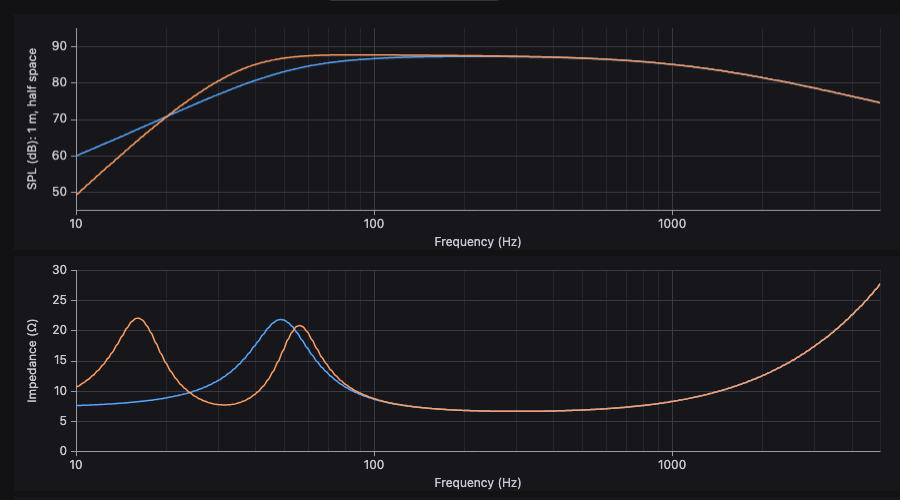
Every design you add is drawn over the last one, so the cost of a change is visible rather than remembered. Sound pressure level, impedance, cone excursion, group delay, port air speed and the maximum level the driver can reach are all on screen together, sharing one frequency axis and one crosshair.
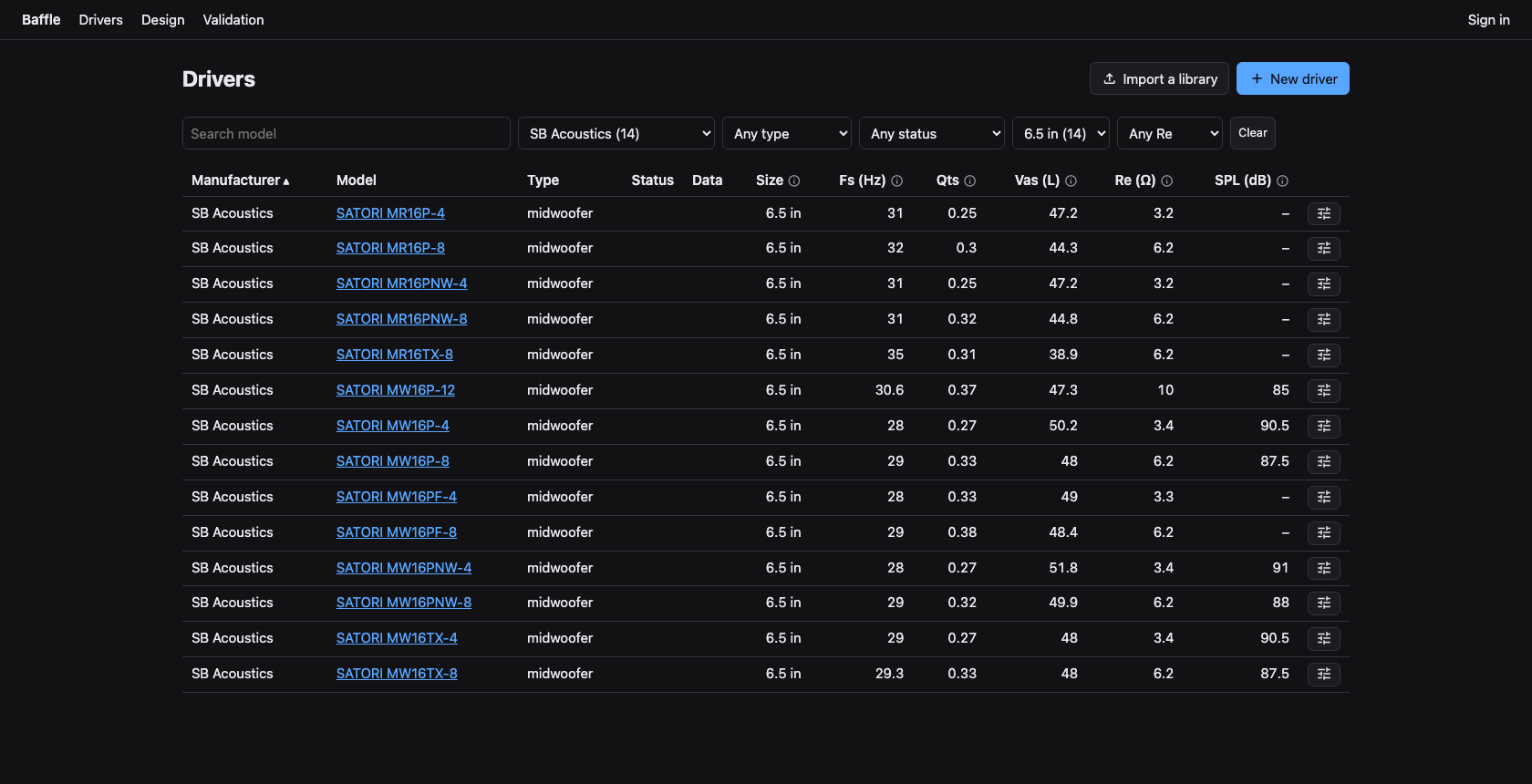
Filter by manufacturer, size, impedance or type and the other filters narrow with you, counts and all. 1,941 of the drivers carry a manufacturer's own published figures with a link to the page they were read from, across 80 makers.
Bring your own instead: a WinISD .wdr library imports in one go, and
your files stay on your machine.
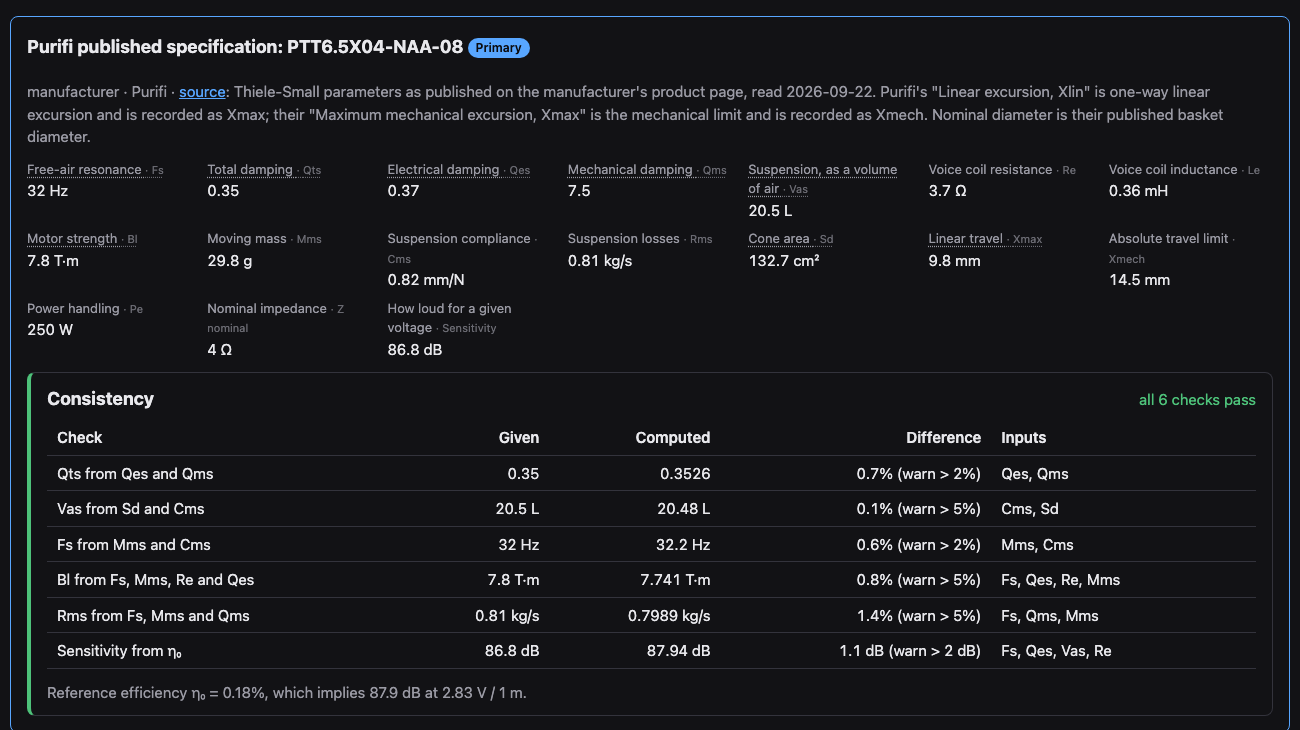
Thiele-Small parameters are not independent: Qts follows from Qes and Qms, Vas from Sd and Cms, Bl from resonance, mass, resistance and electrical damping. Baffle recomputes each one from the others and shows you the difference, so a mistyped digit or a datasheet in the wrong units has somewhere to surface.
Where a driver has been measured and published elsewhere, the page links out to the people who did the work.
The air in the box is the spring. Gentlest rolloff, most forgiving to build.
A port resonates with the box air. Reaches lower for the same driver and volume.
A second cone with no motor does the port's job where a port would be too long.
The cone plays into a chamber and only the port is heard. Louder, over less range.
Two chambers in series, each with a port. Two tunings to place instead of one.
Qts, Vas, group delay, port chuffing, Hofmann's Iron Law: click any of them and a panel opens with what it means, what it does to your design, and what it costs you elsewhere. 35 topics, written for somebody building their first box and useful to somebody building their fortieth.
.wdr library in one go.It takes about fifteen seconds to have a curve on screen.
Start designing